

Insights on HR complexity, process design, and transformation
Practical perspectives on simplifying HR, aligning systems to business goals, and applying AI with intent.
New here? Start with the core idea.
Most HR challenges aren’t isolated. They’re symptoms of deeper complexity across processes, systems, and decision-making. We call this the HR Complexity Tax.
It shows up as:
Fragmented systems
Over-engineered processes
Tools and AI layered onto already complex workflows
Unclear ownership and decision paths
The result? Slower execution, inconsistent experience, and missed business outcomes.
Three Articles to start with


Browse by focus area

HR Complexity Tax
How disconnected processes, layered decisions, and misaligned systems create hidden drag.
Process & Operating Model Design
How HR work is structured, delivered, and governed for clarity and scale.
AI in HR: Beyond the Hype
Applying AI with intent: readiness, process alignment, governance, business value.

HR Transformation & Execution
Turning strategy into sustainable change: adoption, governance, execution.
All Articles
All | HR Complexity Tax | Process & Operating Model | AI in HR | Transformation & Execution
Type
- 5 Pillars 1
- AI Readiness 3
- Adoption Architecture 1
- Assessment 1
- Automation 1
- Change Management 1
- Complexity Drivers 4
- Decision Design 3
- Diagnostic Framework 2
- Five Pillars of HR Transformation 2
- Future of Work 1
- Governance 1
- HR Architecture 1
- HR Complexity Tax 17
- HR Execution 1
- HR Isn't Changing This Year 2
- HR Leadership 1
- HR Operating Model 2
- HR Operations 2
- HR Simplicity Architecture 1
- HR Technology 3
- HR Transformation 10
- Last Mile Architecture 1
- Manager Behavior Change 1
- Operating Model 4
- Operational Clarity 7
- Operational Complexity 5
- Operational Design 8
- Operational Readiness 1
- Organizational Complexity 1
- Over-Design 1
- Practice Infrastructure 1
- Process Architecture 1
- Process Design 8
- Process Maturity 4
- Simplification 6
- Strategic HR 4
- Sustainable HR Systems 4
- Systems Thinking 6
- Technology with Intent 1
- Transformation ROI 1
- Workflow Complexity 1
- Workflow Design 3
- business alignment 1
- fragmentation 1
- system misalignment 1

Why HR Automation Often Makes Work Worse
There’s a strange pattern happening in HR right now. A team identifies a slow, frustrating, inconsistent process. Leadership wants efficiency. Technology gets introduced. Workflow automation gets added. AI gets layered on top. And somehow… the process becomes more complicated. Not less.
The Process Maturity Reality Check
Process maturity isn’t measured by the size of the process map or the sophistication of the system supporting it. It’s measured by something much simpler:
Do people understand how things work?
If they do, the process is probably mature. But if they don’t, the organization may be paying more HR Complexity Tax than it realizes.

The HR Complexity Tax (TM)
Why slow processes, frustrated managers, and under-delivering technology are rarely a capacity problem.
How Complexity Creeps into HR Operations
Most HR leaders don’t choose complexity.
No one wakes up and says” Let’s make this process harder to explain, slower to execute, and dependent on three people who can never take PTO.”
And yet, here we are.
HR operations has quietly become complex over time. Not through one bad decision, but through a series of reasonable ones. Each made with good intent. Each solving a real problem in the moment. Together, they create systems that are brittle, opaque, and increasingly difficult to change. This is how complexity creeps in, and how to recognize it before it calcifies.

HR Isn’t Changing This Year (Part 2)
So Here’s What to Actually Do Instead
Let’s assume that the jokes might actually be right. Maybe HR won’t magically transform this year. Maybe AI won’t fix everything overnight. And maybe your workflows will still be… overengineered. Fine.
If that’s true, here’s what might actually moves HR forward without pretending you’re “AI-native” by next quarter.
How it all fits together
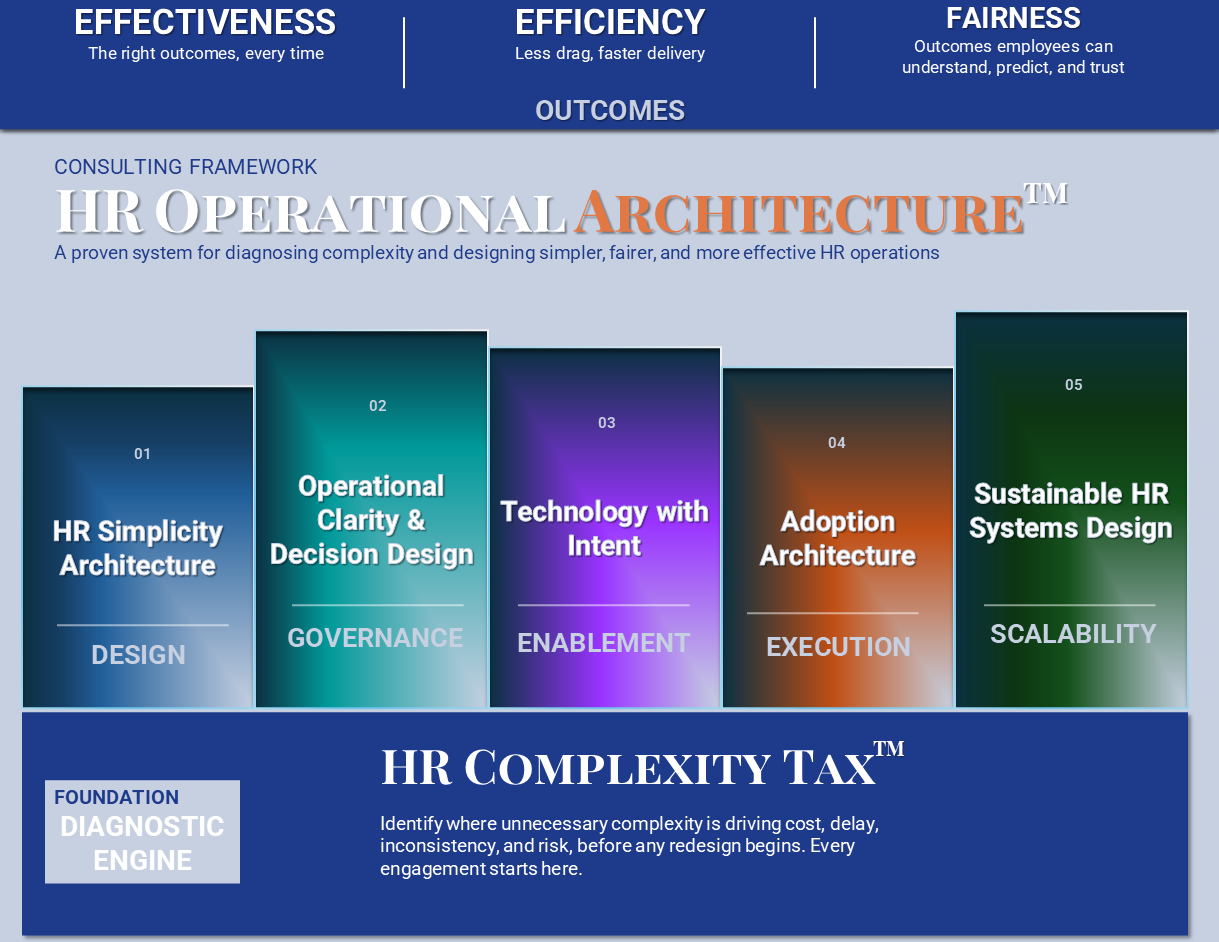
Every article is grounded in the 5 Pillars of HR Transformation, a structured approach to simplifying HR, aligning systems to business goals, and enabling sustainable change.
Rather than treating symptoms, this approach focuses on eliminating complexity at its source.
Reading about complexity? Measure yours.
Understanding HR complexity is the first step. Measuring it is what creates clarity.
Why slow processes, frustrated managers, and under-delivering technology are rarely a capacity problem.