

Insights on HR complexity, process design, and transformation
Practical perspectives on simplifying HR, aligning systems to business goals, and applying AI with intent.
New here? Start with the core idea.
Most HR challenges aren’t isolated. They’re symptoms of deeper complexity across processes, systems, and decision-making. We call this the HR Complexity Tax.
It shows up as:
Fragmented systems
Over-engineered processes
Tools and AI layered onto already complex workflows
Unclear ownership and decision paths
The result? Slower execution, inconsistent experience, and missed business outcomes.
Three Articles to start with


Browse by focus area

HR Complexity Tax
How disconnected processes, layered decisions, and misaligned systems create hidden drag.
Process & Operating Model Design
How HR work is structured, delivered, and governed for clarity and scale.
AI in HR: Beyond the Hype
Applying AI with intent: readiness, process alignment, governance, business value.

HR Transformation & Execution
Turning strategy into sustainable change: adoption, governance, execution.
All Articles
All | HR Complexity Tax | Process & Operating Model | AI in HR | Transformation & Execution
Type
- 5 Pillars 1
- AI Readiness 3
- Adoption Architecture 1
- Assessment 1
- Automation 1
- Change Management 1
- Complexity Drivers 4
- Decision Design 3
- Diagnostic Framework 2
- Five Pillars of HR Transformation 2
- Future of Work 1
- Governance 1
- HR Architecture 1
- HR Complexity Tax 17
- HR Execution 1
- HR Isn't Changing This Year 2
- HR Leadership 1
- HR Operating Model 2
- HR Operations 2
- HR Simplicity Architecture 1
- HR Technology 3
- HR Transformation 10
- Last Mile Architecture 1
- Manager Behavior Change 1
- Operating Model 4
- Operational Clarity 7
- Operational Complexity 5
- Operational Design 8
- Operational Readiness 1
- Organizational Complexity 1
- Over-Design 1
- Practice Infrastructure 1
- Process Architecture 1
- Process Design 8
- Process Maturity 4
- Simplification 6
- Strategic HR 4
- Sustainable HR Systems 4
- Systems Thinking 6
- Technology with Intent 1
- Transformation ROI 1
- Workflow Complexity 1
- Workflow Design 3
- business alignment 1
- fragmentation 1
- system misalignment 1


HR Is Working Hard. Just Not on the Right Things.
System misalignment is the most dangerous structural driver of the HR Complexity Tax because it doesn’t look like a problem from the inside. Programs are running. Metrics are green. But the business is quietly absorbing the cost of an HR function pointed in a slightly different direction than the strategy requires.
Every Step in this Process Was Added for a Good Reason. That’s the Problem.
Over-design is the most defensible form of HR Complexity, because every layer of it was rational at the moment it was added. Understanding why it accumulates, and what it costs, is the work that precedes any meaningful simplification.
Your HR Programs Don’t Talk to Each Other. Your Business Pays for Every Silence.
Most HR transformation efforts focus on improving individual programs.
But organizational complexity rarely lives inside the programs themselves. It lives in the handoffs, dependencies, and disconnects between them.
Your HR programs may be performing exactly as designed. The problem is that they weren't designed to work together.

You Haven’t Simplified HR. You’ve Just Moved the Problem.
Before any HR process is simplified, there is a foundational question that often gets skipped:
What business outcome is this process actually supporting right now?
Not in abstract terms like “efficiency” or “employee experience”. But in operational terms.
How it all fits together
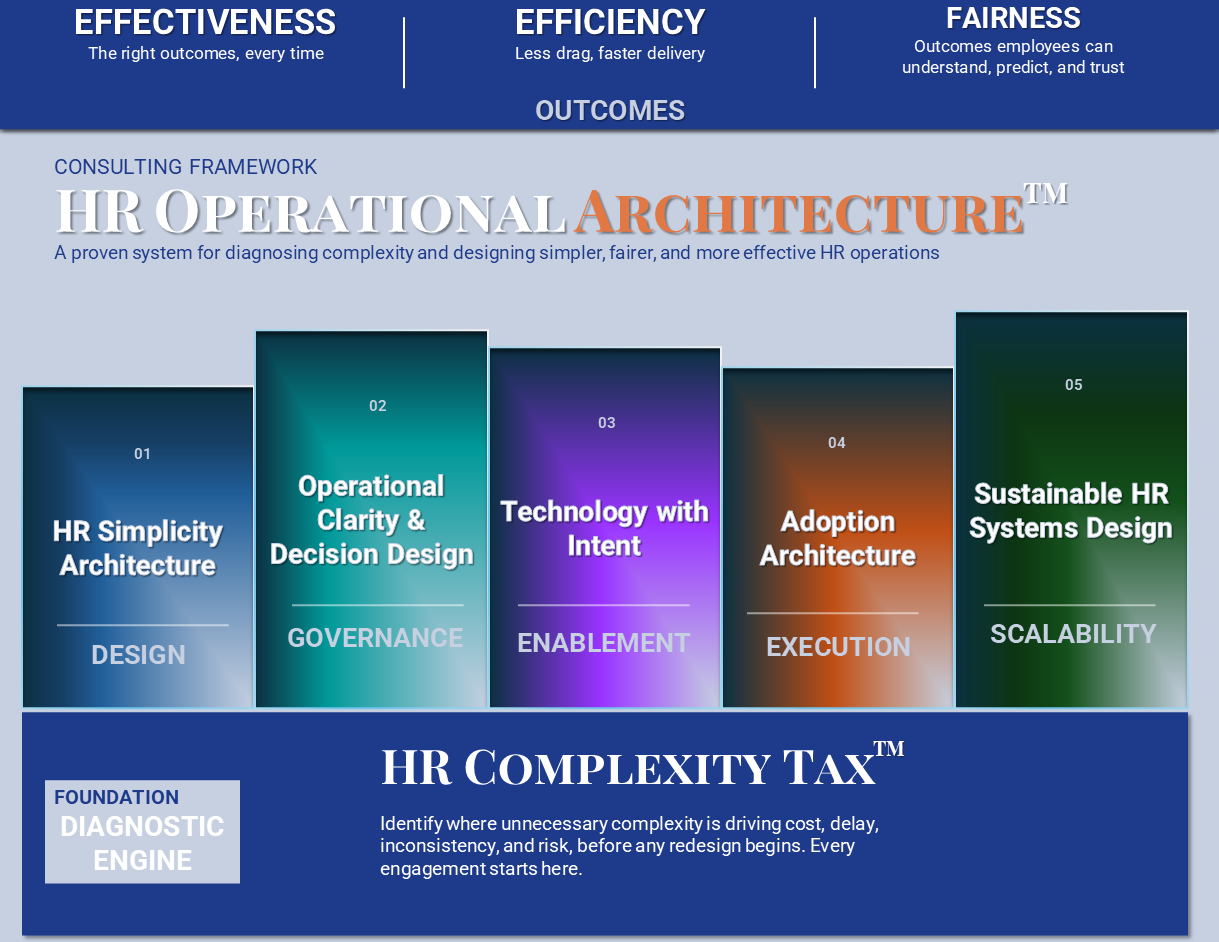
Every article is grounded in the 5 Pillars of HR Transformation, a structured approach to simplifying HR, aligning systems to business goals, and enabling sustainable change.
Rather than treating symptoms, this approach focuses on eliminating complexity at its source.
Reading about complexity? Measure yours.
Understanding HR complexity is the first step. Measuring it is what creates clarity.
Why slow processes, frustrated managers, and under-delivering technology are rarely a capacity problem.