

The Hidden Cost of HR: Complexity
The HR Complexity Tax is Real. And You’re Already Paying it.
It doesn’t show up on a balance sheet. But it slows decisions, frustrates employees, and quietly erodes business performance.
Most organizations don’t set out to create complex HR systems. They build them. One policy, one program, one exception at a time. Until one day, HR isn’t enabling the business. It’s slowing it down. That drag has a cost. We call it the HR Complexity Tax.
Over time, organizations add new policies, processes, technologies, and tools in response to evolving needs.
Each change makes sense in isolation. But collectively, these changes create layers of complexity that make HR harder to operate than it should be.
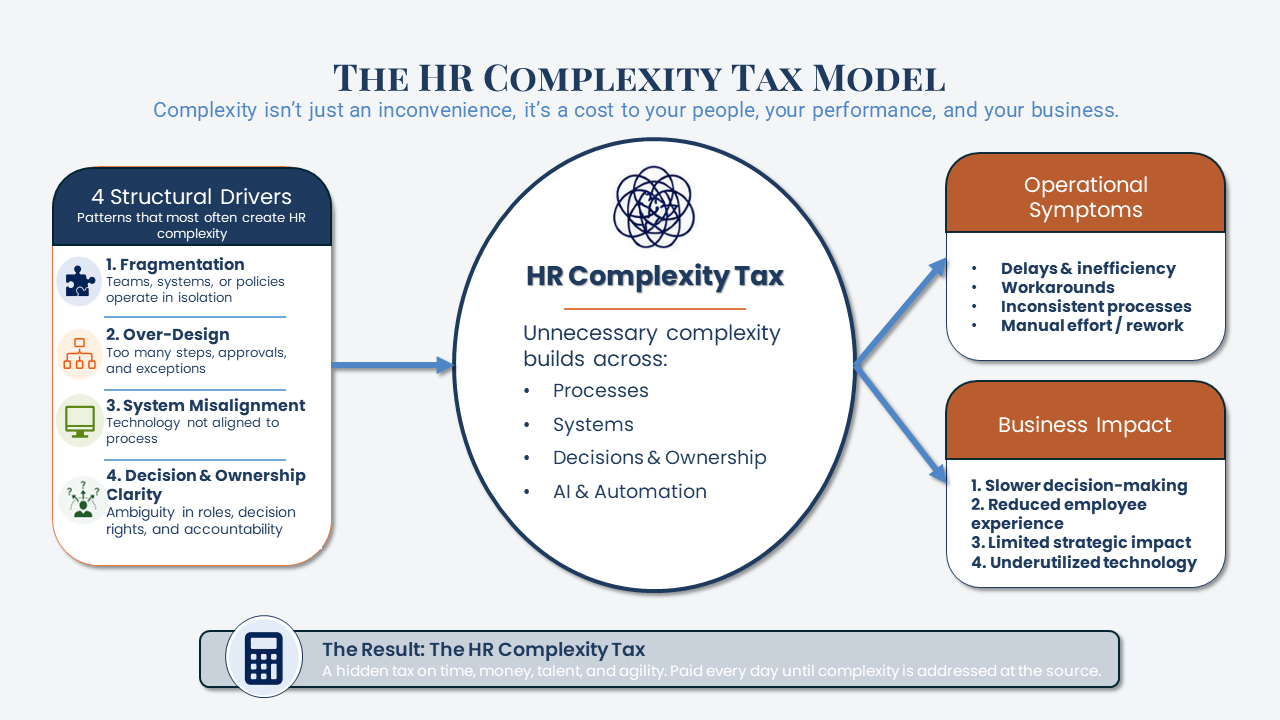
The HR Complexity Tax is the accumulated cost of that complexity. It shows up in many forms:
Processes that require too many steps
Systems that don’t fully integrate
Manual workarounds to compensate for gaps
Decision-making that lacks clarity or ownership
Technology, including AI, that creates more effort instead of less
None of these problems exist on their own. They interact and compound.
And over time, they slow everything down. This isn’t about inefficiency. It’s about the misalignment between how HR operates and how the business needs to move.
What is the HR Complexity Tax?
How Complexity Quietly Takes Hold
HR Complexity rarely appears overnight. It builds gradually through well-intentioned decisions.
A new policy is introduced to address a specific need.
A system is added to improve efficiency.
A program is launched to solve for engagement.
A workaround is created to solve a gap.
Individually, each decision makes sense. But over time, these layers begin to stack and interact in unexpected ways by creating friction, duplication, and misalignment across the HR ecosystem.
What started as progress turns into over-engineering. What started as support becomes friction.
And since no one owns the whole system, no one simplifies it.
Over time, this buildup of decisions tends to follow recognizable patterns. Understanding those patterns is the key to reducing complexity.
The Structural Drivers of the HR Complexity Tax
While complexity builds over time, it is typically driven by a consistent set of underlying patterns. At emPowers People | Systems, we see four structural drivers that most often contribute to the HR Complexity Tax.
Understanding these drivers makes it easier to recognize where simplification can have the greatest impact.
-
Fragmentation occurs when different teams, systems, or policies operate in isolation. Each group focuses on improving its own part of the HR experience, but without a shared view of the entire process. As a result:
Processes become inconsistent across teams
Employees receive different experiences depending on where they interact
Data becomes difficult to consolidate and interpret
Ownership of decisions becomes unclear
What begins as localized optimization eventually creates organizational friction. And the more fragmented the system becomes, the harder it is for HR to operate as a cohesive function.
-
HR processes often become overly complex because they are designed to account for every possible scenario. Additional approvals, decision points, and exceptions are introduced over time in an effort to manage risk or maintain control. While these additions are usually well-intentioned, they can lead to:
Processes with too many steps
Approvals that slow decision-making
Policies that are difficult for employees and managers to understand
Workflows that are harder to maintain or automate
Over-design turns what should be straightforward processes into complicated operational structures.
-
Many organizations invest significantly in HR technology, yet still struggle to achieve efficiency. This often happens because systems, and increasingly AI tools, are implemented without fully aligning them to the processes they are meant to support. When technology, data. and workflow are not designed together, organizations experience:
Duplicate data entry
Workaround outside of core systems
Platforms that employees find difficult to use
AI tools layered on inefficient processes
Insights that lack context of are difficult to act on
Confusion about when and how AI should be used
In these environments, technology and AI become something HR has to manage rather than tools that simplify work and enable better decisions.
-
HR processes are designed to ensure alignment, consistency, and control, yet still struggle to move work forward efficiently. This often happens because ownership and decision rights are not clearly defined or consistently applied across the process. When roles and decision paths are unclear, organizations experience:
Decisions that require multiple approvals or repeated input
Delays as work is escalated to clarify accountability
Conflicting actions across teams or stakeholders
Rework caused by misaligned or unclear decisions
Over-reliance on informal coordination to move work forward
In these environments, progress slows. Not because of the work itself, but because accountability and decision-making are unclear.
You don’t need a formal audit to know it’s there. Many organizations recognize the symptoms of complexity before they recognize the cause. You may see:
Processes that feel slower than they should
HR teams spending more time managing systems than enabling people
Employees and managers struggling to navigate HR processes
Data that is difficult to trust or interpret
AI tolls introduced with high expectations but unclear impact
These signals often point to deeper structural issues within the HR ecosystem.
When complexity builds unchecked, HR spends more energy maintaining the system than improving it.
Signs Your Organization Is Paying the HR Complexity Tax
If these challenges sound familiar, the next step is understanding where complexity is entering your HR ecosystem.
Why the HR Complexity Tax Matters
Complexity doesn’t just affect HR operations. It shapes how decisions are made, how employees experience the organization, and how effectively the business operates.
When HR processes, systems, and tools become overly complex, the impact is not just operational, and the consequences extend beyond efficiency.
Organizations experience:
Slower Decision-Making
Leader lack the clarity and insights they need to act quickly, slowing decisions, increasing dependencies, and delaying execution.
Reduced Employee Experience
Processes become harder for employees and managers to navigate, creating inconsistency, frustration, and lower engagement.
Limited Strategic Impact
HR’s capacity shifts toward managing friction instead of enabling business priorities and outcomes.
Underutilized Technology
Investments in HR systems and AI fail to deliver value due to misalignment, poor adoption, or unnecessary complexity.
Over time, the cost of complexity compounds.
And the organization pays the price.
The result isn’t just inefficiency. It’s a hidden tax on performance.
Addressing HR complexity requires more than fixing individual problems. It requires a connected approach that aligns strategy, processes, technology, and adoption.
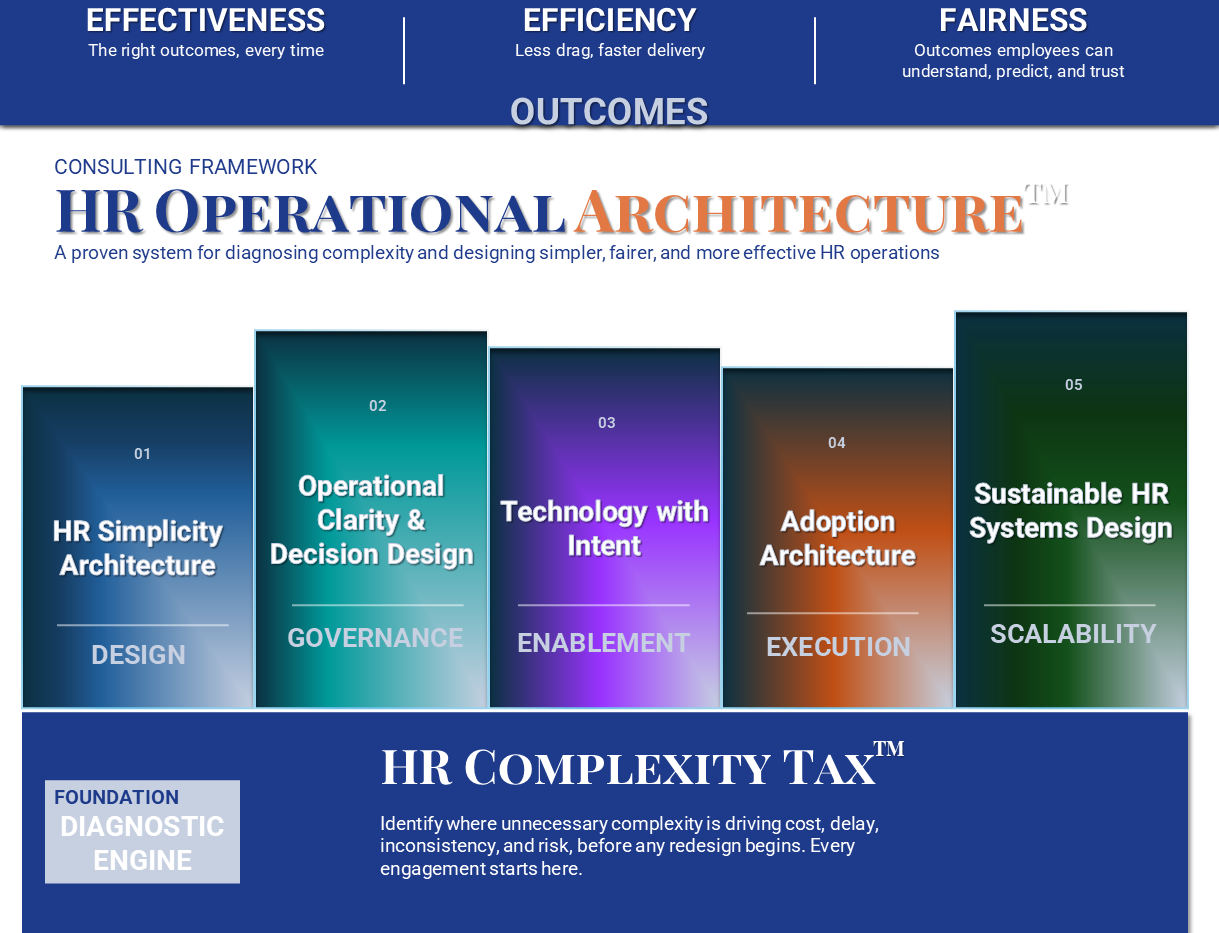
At emPowers People | Systems, we address complexity through our 5 Pillars of HR Transformation:
HR Simplicity Architecture
Eliminating unnecessary complexity at its source
Operational Clarity & Decision Design
Creating clear and scalable ways of working
Technology with Intent
Ensuring HR systems and AI serve the organization’s goals
Adoption Architecture
Helping teams adopt change successfully
Sustainable HR Systems Design
Building solutions that remain effective as the organization grows
Together, these pillars create a foundation for simplifying HR and unlocking its full strategic potential.
Reducing the HR Complexity Tax
How the HR Complexity Tax Builds Over Time
Measure Your HR Complexity
The first step toward reducing complexity is understanding where it exists.
Our assessments help organizations identify where the HR Complexity Tax is impacting their processes, systems, and strategy.
You can start it in one of two ways:
Single Process Complexity Assessment
Focus on a specific HR process and identify where complexity is slowing it down.
HR Complexity Self-Assessment
Evaluate how complexity affects your HR organization as a whole.
Clarity is the First Step Toward Transformation
The HR Complexity Tax affects more organizations that most leaders realize. But once it becomes visible, it can be addressed.
Most organizations try to transform HR by adding more. More tools. More programs, More structure. But transformation doesn’t start with addition.
It starts with clarity.
Start by measuring where complexity exists, and take the first step toward building a simpler, more effective HR function.
Most organizations don’t see it, until it slows everything down.
Ready to See Your Complexity Clearly?
Assess where your organization is accumulating unnecessary friction, and where simplification will have the biggest impact.