

Insights on HR complexity, process design, and transformation
Practical perspectives on simplifying HR, aligning systems to business goals, and applying AI with intent.
New here? Start with the core idea.
Most HR challenges aren’t isolated. They’re symptoms of deeper complexity across processes, systems, and decision-making. We call this the HR Complexity Tax.
It shows up as:
Fragmented systems
Over-engineered processes
Tools and AI layered onto already complex workflows
Unclear ownership and decision paths
The result? Slower execution, inconsistent experience, and missed business outcomes.
Three Articles to start with


Insight Library
Perspectives, frameworks, deep dives, and practical guidance focused on operational design, HR transformation, AI readiness, and reducing organizational complexity.
Browse by focus area, content type, or strategic theme to explore the topics most relevant to your organization.
Insights By Content Type
Insights By Focus Area
AI in HR - Beyond the Hype | HR Transformation & Execution
Insights By Strategic Themes
Operational Design | Business Alignment | Systems Thinking
AI Readiness | Process Simplification | Decision Architecture

Your HR Programs Don’t Talk to Each Other. Your Business Pays for Every Silence.
Most HR transformation efforts focus on improving individual programs.
But organizational complexity rarely lives inside the programs themselves. It lives in the handoffs, dependencies, and disconnects between them.
Your HR programs may be performing exactly as designed. The problem is that they weren't designed to work together.
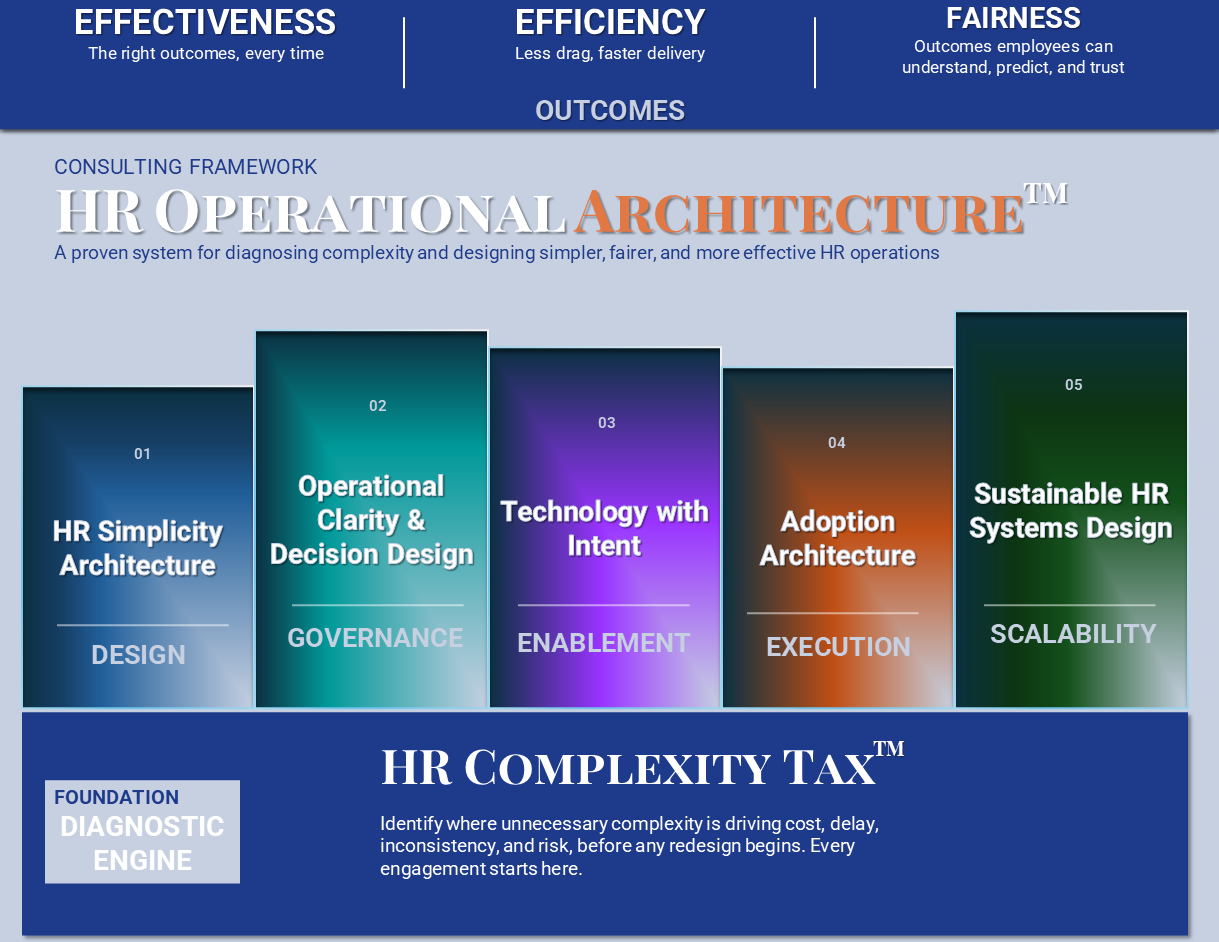
How it all fits together
Every article is grounded in the 5 Pillars of HR Transformation, a structured approach to simplifying HR, aligning systems to business goals, and enabling sustainable change.
Rather than treating symptoms, this approach focuses on eliminating complexity at its source.
Reading about complexity? Measure yours.
Understanding HR complexity is the first step. Measuring it is what creates clarity.
Why slow processes, frustrated managers, and under-delivering technology are rarely a capacity problem.