

Insights on HR complexity, process design, and transformation
Practical perspectives on simplifying HR, aligning systems to business goals, and applying AI with intent.
New here? Start with the core idea.
Most HR challenges aren’t isolated. They’re symptoms of deeper complexity across processes, systems, and decision-making. We call this the HR Complexity Tax.
It shows up as:
Fragmented systems
Over-engineered processes
Tools and AI layered onto already complex workflows
Unclear ownership and decision paths
The result? Slower execution, inconsistent experience, and missed business outcomes.
Three Articles to start with


Browse by focus area

HR Complexity Tax
How disconnected processes, layered decisions, and misaligned systems create hidden drag.
Process & Operating Model Design
How HR work is structured, delivered, and governed for clarity and scale.
AI in HR: Beyond the Hype
Applying AI with intent: readiness, process alignment, governance, business value.

HR Transformation & Execution
Turning strategy into sustainable change: adoption, governance, execution.
All Articles
All | HR Complexity Tax | Process & Operating Model | AI in HR | Transformation & Execution

The HR Function Nobody Built.
Start with the decisions the business needs to make, not the org chart. Ten counter-intuitive principles for building HR around business outcomes.

HR Is Working Hard. Just Not on the Right Things.
Programs on schedule, metrics green, and the business still isn’t getting what it needs. How system misalignment hides inside a busy HR function.

You Haven’t Simplified HR. You’ve Just Moved the Problem.
Before any HR process is simplified, there is a foundational question that often gets skipped:
What business outcome is this process actually supporting right now?
Not in abstract terms like “efficiency” or “employee experience”. But in operational terms.
HR Transformation Fails When HR Processes Aren’t Designed Around Business Outcomes
Most HR transformation efforts start in the wrong place. They start with technology selection. Or organizational redesign. Or AI strategy. Or operating model discussions. Or a new service delivery structure. Or a roadmap full of initiatives. But very few start with the question that should sit underneath all of them:
What business outcome is this HR process actually supposed to improve?
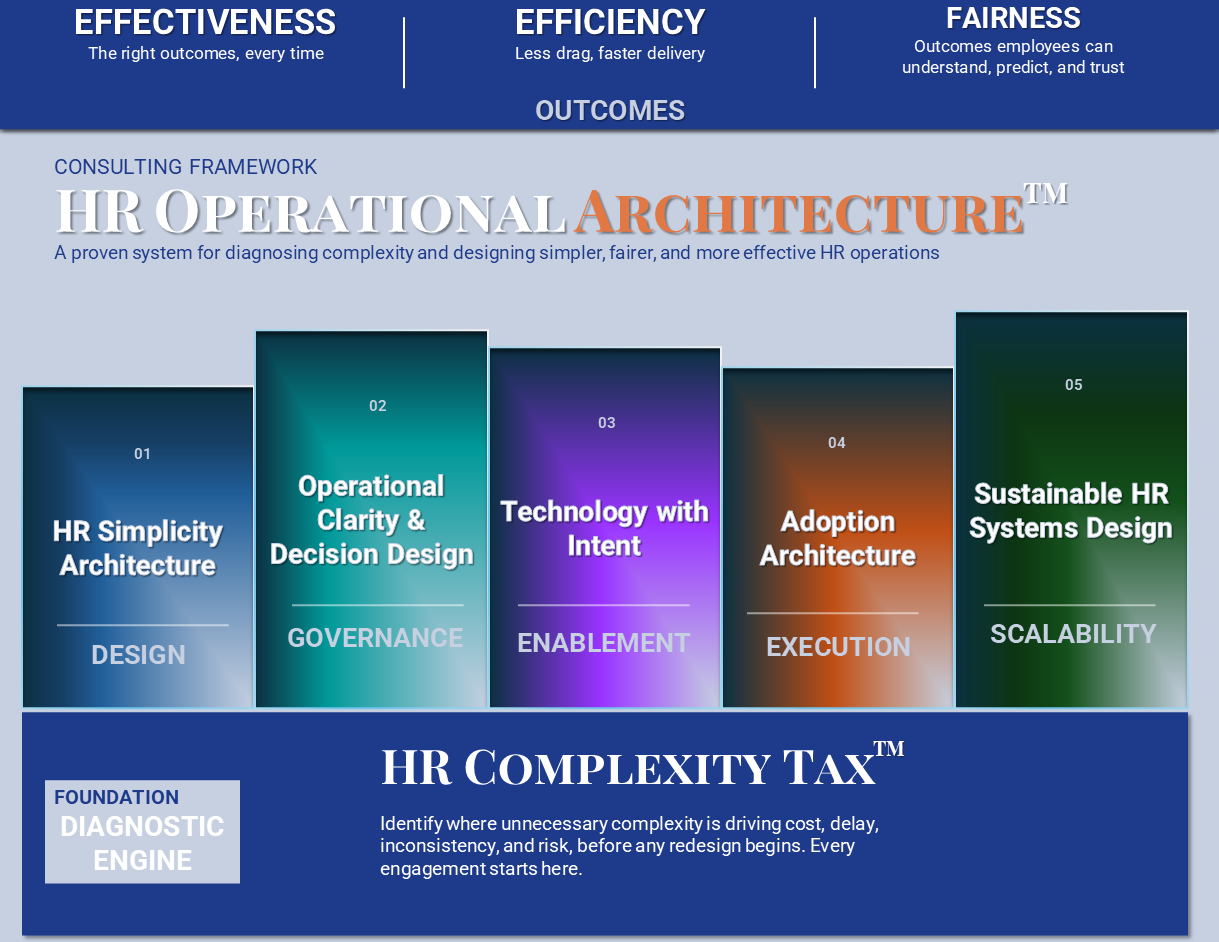
How it all fits together
Every article is grounded in the 5 Pillars of HR Transformation, a structured approach to simplifying HR, aligning systems to business goals, and enabling sustainable change.
Rather than treating symptoms, this approach focuses on eliminating complexity at its source.
Reading about complexity? Measure yours.
Understanding HR complexity is the first step. Measuring it is what creates clarity.
Why slow processes, frustrated managers, and under-delivering technology are rarely a capacity problem.